
For more than 70 years, scientists and engineers have been baffled by the thunderous roar of jet engines — a problem that has hindered quieter, more community‑friendly aviation and made supersonic flight over land nearly impossible. But now, a team of Florida researchers may have finally cracked the code, uncovering the elusive physics behind jet noise and crafting a new way to reduce and eventually stop the ear‑splitting sound at its source. Their breakthrough not only peels back decades of aerodynamic mystery but also could revolutionize aircraft design, bringing us closer to flights that are both faster and far quieter.
New research aims to tame the roar of supersonic jets
Researchers at the FAMU-FSU College of Engineering, in collaboration with the Florida Center for Advanced Aero-Propulsion (FCAAP), are tackling a longstanding safety challenge in military aviation: the deafening noise produced by supersonic jets during takeoff and landing.
Their new study, published in the Journal of Fluid Mechanics, introduces a model that explains how supersonic jets interact with the ground or nearby structures, creating a resonant feedback loop that can amplify sound to dangerously high levels.
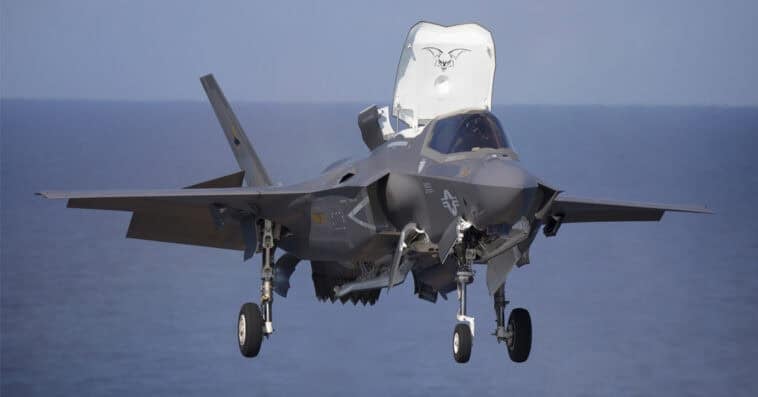
The team focused on aircraft like Short Takeoff and Vertical Landing (STOVL) jets — such as the F-35B Lightning II — which can operate without traditional runways, giving them crucial tactical advantages. However, as these jets descend, their exhaust plumes collide with landing surfaces, producing extreme noise that often exceeds 140 decibels.
For aircraft, these powerful vibrations speed up structural wear and tear and can even create dangerous low-pressure zones that pull the plane closer to the ground. For personnel on the ground, prolonged exposure to noise exceeding 140 decibels can lead to permanent hearing loss, even with protective gear. At the highest levels, the intense acoustic pressure is strong enough to damage internal organs, highlighting just how extreme and hazardous supersonic jet noise can be.
By developing a new model to predict how these air currents collide with the ground, the Florida-based team is providing the blueprint needed to finally quiet these high-tech giants and protect the people who operate them.
“Only a tiny fraction of the jet’s energy is transformed into sound, but this small fraction has a major impact,” said Farrukh S. Alvi, professor in the Department of Mechanical and Aerospace Engineering and former founding director of the Institute for Strategic Partnerships, Innovation, Research, and Education, or InSPIRE, and founding director of FCAAP. “The intense noise produced by jet engines can cause structural damage to the aircraft and damage the hearing of personnel on the ground. We are trying to understand the physics behind these supersonic jets and the noise they produce so that we can develop tools that can reduce their impacts. In fact, we have already had some success in developing techniques that can reduce jet noise.”
What the research discovered about jet noise
To uncover the hidden patterns surrounding jet noise, the research team pushed a jet to Mach 1.5—one and a half times the speed of sound. By adjusting the engine’s pressure and its distance from the ground, they simulated the exact conditions of a real-world takeoff and landing.
Capturing the invisible
The team used a high-speed camera and a special technology called schlieren imaging, which essentially allows scientists to “see” air. This allowed them to watch large disturbances in the air and the resulting sound waves as they happened in real time. Simultaneously, ultra-sensitive microphones recorded every roar and whistle.
They discovered that when the jet gets truly loud, the air and sound waves follow a steady, repeating rhythm—a sure sign of a resonant cycle. By syncing their images with this rhythm, they could track how fast air disturbances moved and how sound waves traveled back up toward the engine.
The secret to the pitch
The biggest breakthrough involved acoustic standing waves. These are sound waves that appear to stay perfectly still between the jet and the ground.
Previously, experts thought the speed of air disturbances controlled the pitch (how humans perceive the frequency of sound waves). This study proved that wrong. Instead, they found that these standing waves control the pitch, while the size and speed of air disturbances determine the “loudness” or volume.
“That was surprising,” said lead author and researcher Myungjun Song. “We found that these acoustic standing waves are much more important in determining the pitch, while the size and speed of the disturbances decide the level or ‘loudness’ of the noise produced.”
Why these findings matter
Because the speed of air disturbances doesn’t change the pitch, engineers now only need to look at the standing waves to predict what kind of noise a jet will make. This new model is a game-changer; it allows designers to build safer aircraft and landing pads that can break these noise loops before they become dangerous.
Source: Florida State University News