
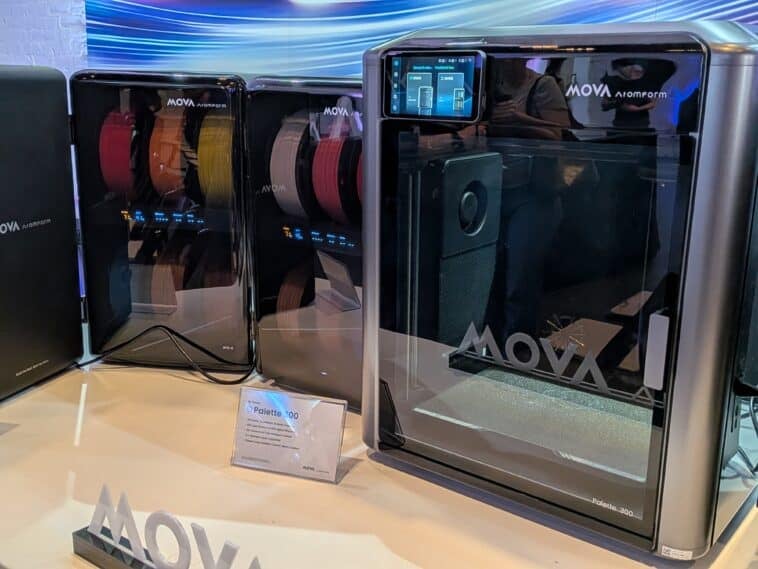
If your mental image of a 3D-printed object is a monochrome and perhaps slightly lopsided plastic toy, it’s time for an update — 3D printing in 2026 is capable of making objects out of multiple materials and colors, with applications from medicine to construction to spare parts for repair jobs. And, thanks to Mova, 3D printing is about to be capable of even more. At an event in San Jose this week, the company presented the Mova AtomForm Palette 300, which promises to enable more complex print jobs while cutting down on wasted material by as much as 90%.
More materials, less waste
How? That requires a brief description of how 3D printing works. First, a 3D model is sent to a 3D printer, which is usually a large box that sort of resembles a mini-fridge. Then, a spool of filament (often some kind of plastic) is fed through a nozzle that heats the filament until it’s molten. Using a mobile print base and precise movements of the nozzle, the printer builds the 3D model using that filament, and you hope that whoever designed the 3D model was a good enough engineer to design something that doesn’t fall apart!
In the early days, you had one spool of filament — one kind of material, in one color. Printing using multiple materials and colors became possible, but required manual switching of spools. That’s a tough ask, since print jobs can take hours, and folks generally aren’t able to stay with their printer the whole day. This also led to a lot of waste, since filament already fed into the nozzle would need to be cut off and fully pushed out before the next material or color could be fed through, leading to infamous waste piles on 3D printer bases.
The Mova AtomForm Palette 300 attacks those problems with a new approach — an automated nozzle switcher. Mova’s debut 3D printer has a chamber with 12 nozzles ready to jump into action when a material or color change is called for. Instead of feeding through wasted material, the filament is cut off and left in the active nozzle, which is automatically removed and replaced by one of the other 12 nozzles.
It’s a fully automated system that requires no intervention during the print job. The AtomForm Palette 300 can be hooked up to six boxes at once, each of which can hold six spools of filament — if you’re only using one kind of material, that means you can run print jobs that use up to 36 different colors without needing to manually swap out filament spools. With a 300mm x 300mm x 300mm capacity, the printer can handle fairly large designs, too — it’s about mid-sized in comparison to most other 3D printers on the market.
3D printing gets speedier and smarter
The design makes this 3D printer remarkably fast, too — Mova says it’s capable of up to 800mm/s print speeds. When the printer detects that its current print job is about to require a material or color change, the next filament is fed through a chamber next to the active filament. When a nozzle is swapped out, the active filament is cut off and the next filament is fed through the new nozzle with little delay. The printer also actively dries filament, to ensure moisture doesn’t harm the print job.
From the outside, print jobs will look a lot smoother, but under the hood, the Palette 300 represents a dizzying amount of complexity. Mova has used 50 sensors in their new 3D printer, including cameras, temperature sensors, and motion detectors, which are all tied to AI processing that helps ensure operating temperatures are appropriate for each material used. The sensors can also detect what kind of filament has been left in each nozzle, ensuring that the printer doesn’t swap in a nozzle with the wrong kind of filament. Those sensors can also prevent damage or failed prints by detecting nozzle clogs and swapping nozzles immediately — that means no coming home to a half-done print job that stopped because of a clog, which is huge news for folks who print in bulk and sell their products online.
What took so long?
Now for the obvious question: if nozzle switching is such a good idea, why hasn’t it been done before? That’s partly because of the complexity of switching nozzles while maintaining proper calibration. The calibration problem might have found its match thanks to AI — algorithms working with all those sensors to recalibrate the printer quickly as nozzles are swapped.
However, there are also durability concerns — what if nozzles wear out too quickly as they repeatedly are taken on and off the print head? That could prevent a proper seal, which keeps filament from being fed through the nozzle cleanly. To address those concerns, Mova has used hardened steel components. Time will tell if that’s enough to make those nozzles hold up to repeated, high-volume use.
3D printing for everyone
It’s an impressive piece of technology for enthusiasts, especially for folks who 3D print objects in bulk. But, Mova wants the AtomForm Palette 300 to be welcoming to beginners, too. They’re pairing their 3D printer with their own software, which promises to be a one-stop shop for all things 3D printing. Users will be able to browse for 3D models, edit them, tinker with colors and materials, and send the job to the printer all from one place. They will even be able to sell their own designs on the platform. As of now, PC software is planned — no word on a mobile app.
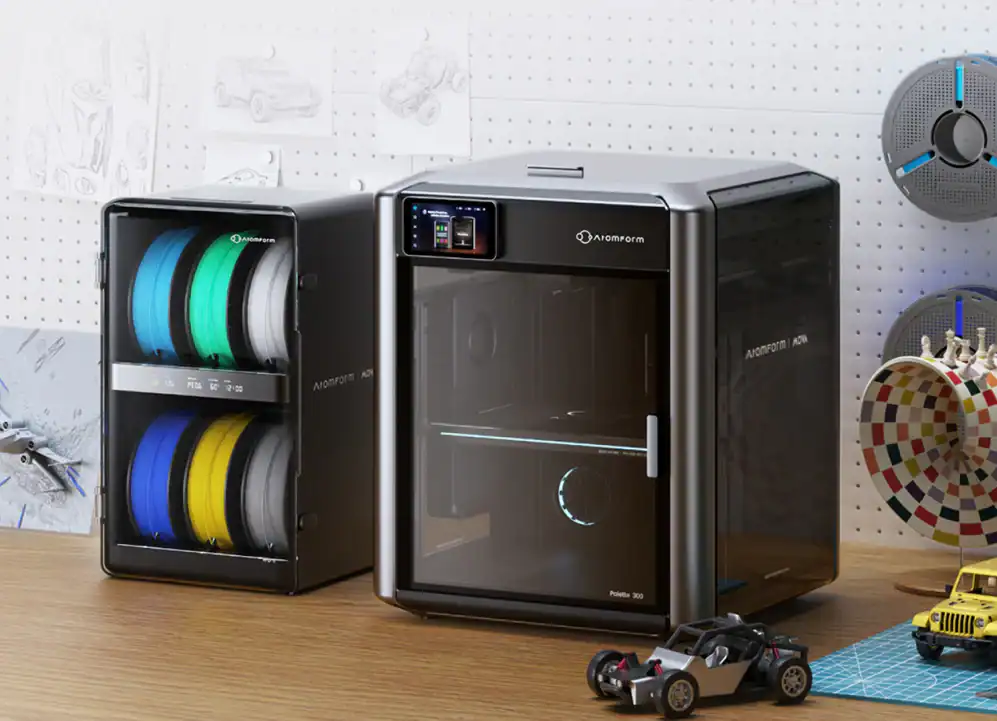
Mova is planning to launch a Kickstarter campaign for the AtomForm Palette 300 soon, but they already have an offer — a $50 deposit to secure a $1,000 launch price, instead of the $2,200 it will normally sell for. Hard to say when the printers will start shipping — Mova didn’t demo the printer at their San Jose event, although they did have a display model on hand — but we should know more in the weeks and months to come.