
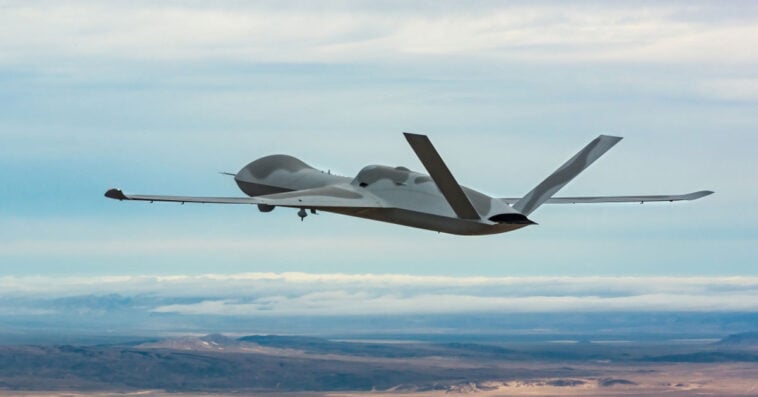
For decades, the idea of fighter pilots flying side by side with intelligent machines felt like science fiction — but in 2026, it becomes reality. The United States Air Force is beginning to integrate robotic wingmen into real-world flight operations, pairing aircraft such as the F-22 Raptor with autonomous drones like the MQ-20 Avenger in carefully controlled exercises. The milestone signals a major shift in how missions are planned and executed, with human pilots supported by advanced AI systems designed to enhance awareness and reduce risk. Read on to learn more about this radical evolution in manned-unmanned teaming and how it is fundamentally changing the definition of teamwork in the sky.
F-22 Raptor and MQ-20 Avenger complete landmark manned-unmanned flight test
The skies over California recently played host to a glimpse of the future as the U.S. Air Force and General Atomics Aeronautical Systems, Inc. (GA-ASI) successfully bridged the gap between human intuition and machine precision. In a landmark exercise at Edwards Air Force Base, a human-piloted F-22 Raptor took on the role of a digital conductor, directing an unmanned MQ-20 Avenger through a series of complex tactical maneuvers in real time.
This wasn’t just a remote-controlled flight; it was a sophisticated display of “Manned-Unmanned Teaming”. Using advanced autonomy software, the F-22 issued high-level commands while the MQ-20 used its own sensors to “think” on the fly.
Breaking down the tech
During the demonstration, the MQ-20 carried out multiple mission sets after receiving instructions from the F-22, including waypoint adjustments, combat air patrol patterns, and simulated airborne threat engagements. The drone effectively operated as a force extender for the crewed aircraft, responding dynamically as the scenario evolved.
The test combined government-developed reference autonomy software aboard the F-22 with GA-ASI’s Autonodyne Bashi Pilot Vehicle Interface installed on the MQ-20, creating a seamless command-and-control loop between the two platforms.
Equipped with onboard sensors, the MQ-20 processed environmental data independently, coordinated maneuvers, and exchanged tactical messaging with the F-22 throughout the flight. This proves that the drone wasn’t just a follower, but a collaborative partner in a continuous command loop.
Reflecting on the milestone, General Atomics President David R. Alexander said in a press release, “We appreciate the flawless execution of this mission using the government’s advanced autonomous systems. This demo featured the integration of mission elements and the ability of autonomy to utilize onboard sensors to make independent decisions and execute commands from the F-22.”
Why this matters
For over five years, the MQ-20 has served as a critical “surrogate” for the military’s Collaborative Combat Aircraft (CCA) program. This latest success proves that drones can do more than fly preset routes—they can act as force multipliers that adapt to the heat of a mission alongside a human leader. As the Air Force prepares for a 2026 rollout, the bond between pilot and robot is no longer a theory; it’s a flight-proven reality.
General Atomics accelerates CCA timeline with new autonomy breakthrough
The recent flight demonstration is just one of the recent developments on GA-ASI’s fast-moving progress under the Collaborative Combat Aircraft (CCA) initiative.
Earlier this month, on February 12, the U.S. Air Force confirmed that its Autonomy Government Reference Architecture had been successfully validated across several industry partners. This standardized system allows software from various companies to work on different drones seamlessly.
As part of that milestone, Collins Aerospace’s Sidekick autonomy software was successfully integrated onto GA’s YFQ-42A CCA, enabling the aircraft’s first semi-autonomous airborne mission.
During testing, the aircraft, dubbed the Dark Merlin, operated for more than four hours while executing detailed commands under the supervision of a ground operator, demonstrating dependable data-sharing and autonomy performance. Those results reinforce the technical foundation required for advanced manned-unmanned coordination, including the recent pairing of the MQ-20 Avenger with the F-22 Raptor.
Both tests show a massive shift in how the U.S. Air Force views its “fifth-generation” fighters. Instead of the pilot doing everything, the goal of this teaming concept is to turn the pilot into a mission commander. By delegating tactical chores to drones, the human stays safer and more focused on the big picture.
Sources: GA-ASI, Defense News