
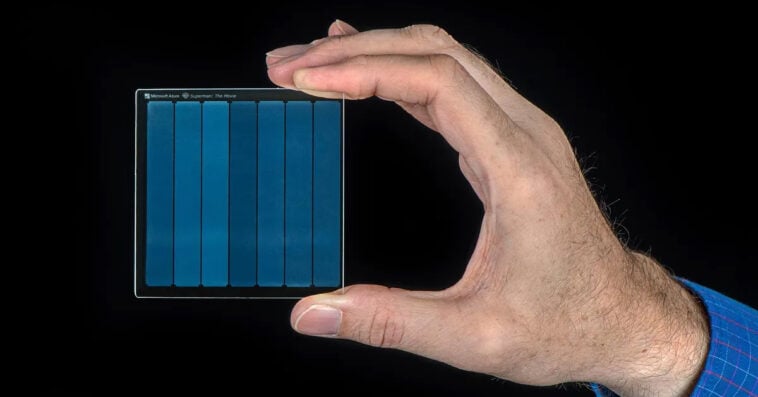
Imagine a future where your kids’ baby videos, your grandparents’ wedding photos, and every cherished memory you’ve ever saved don’t vanish with outdated hard drives or corrupted cloud backups but instead endure for 10,000 years, etched into a piece of glass. That’s the astonishing promise behind the latest breakthrough in Microsoft’s Project Silica, in which researchers have cracked the code for storing massive amounts of data inside ordinary borosilicate glass. Curious how this sci‑fi‑worthy tech works and what it could mean for preserving data — and your own family’s legacy? Read on.
Microsoft’s massive leap in glass data storage
Traditional digital storage is surprisingly fragile, but Microsoft is shattering those limitations with a breakthrough in Project Silica. Since its debut in 2019, this ambitious research initiative has sought to move humanity’s data away from decaying hard drives and onto something far more permanent: glass. Now, after five years of refinement, the team has reached a pivotal milestone that could bring “eternal” storage to the masses.
In a surprising twist recently published in the journal Nature, Microsoft researchers discovered that the key to scalable data storage isn’t a rare, synthetic material, but something you likely already have in your pantry. While the project initially relied on expensive fused silica, the team successfully transitioned to ordinary borosilicate glass—the same heat-resistant material used to make durable laboratory glassware like Pyrex.
This shift from specialized silica to “everyday” glass is a game-changer for two reasons:
- Affordability: Borosilicate is significantly cheaper to produce, removing a massive financial barrier to large-scale adoption.
- Accessibility: Because this glass is already mass-produced for various industries, sourcing the raw materials for global data centers is no longer a logistical nightmare.
How long can glass store data?
Microsoft’s researchers aren’t just experimenting with storing data in glass — they’re also figuring out how long it can last. According to Partner Research Manager Richard Black, the team has developed a method to test the longevity of their glass-based storage using accelerated aging techniques. The findings are staggering: even with the more affordable and widely available borosilicate glass, the data could remain intact for up to 10,000 years.
“We have unlocked the science for parallel high-speed writing and developed a technique to permit accelerated aging tests on the written glass, suggesting that the data should remain intact for at least 10,000 years,” said Black.
This breakthrough not only demonstrates the technology’s durability but also signals a new era in ultra-long-term data preservation.
How glass data storage actually works
Microsoft’s Nature paper reveals a remarkable feat: hundreds of layers of data compressed into a glass sheet barely 2mm thick. When Project Silica debuted in 2019, the machines needed to write data to glass were massive and unwieldy. Microsoft promised to shrink the technology — and now that vision has become reality.
Gone are the days of relying on three or four cameras to read the data. Today, a single camera suffices, and the devices on the right side of the setup have been simplified, making them faster to build, calibrate, and operate. This streamlining accelerates the entire process of writing information to glass.
To illustrate the progress, Microsoft successfully stored 4.8TB of data on a piece of glass measuring just 2mm by 120mm (roughly 0.08 x 4.72 inches), split across 301 layers, at a speed of around 3.13MB/s. While that’s nowhere near the blistering pace of modern SSDs topping 14,000 MB/s, the real marvel is the longevity: this data could remain readable for 10,000 years — making speed a secondary concern when compared with survival over millennia.
Why glass is the future of data
Our current digital world is built on a foundation of sand. The traditional methods we rely on to store the world’s most important information are far from permanent. In fact, even the most advanced data centers face a constant battle against “bit rot” and hardware failure, as standard storage media typically reaches its expiration date in just one or two decades.
As the amount of data we generate grows at an astronomical rate every single day, the way we house that information has become a critical business and environmental issue. Moving toward glass storage isn’t just a tech upgrade; it’s also a massive win for the planet.
The current status quo for large-scale storage is incredibly resource-intensive. Traditional magnetic media, like hard drives and tapes, require:
- Constant climate control: High energy costs to keep hardware cool.
- Frequent replacement: The “refresh cycle” requires manufacturing new drives every few years.
- Active maintenance: Constant monitoring to prevent data loss.
In contrast, Microsoft’s Project Silica offers a “set it and forget it” solution. Once data is etched into a piece of glass, it can be tucked away safely for the next 100 centuries without requiring a single watt of power to keep the data alive. This shift represents a monumental step toward a more sustainable digital legacy, trading high-maintenance machinery for the silent, enduring strength of glass.
Sources: Nature, Microsoft, Windows Central