
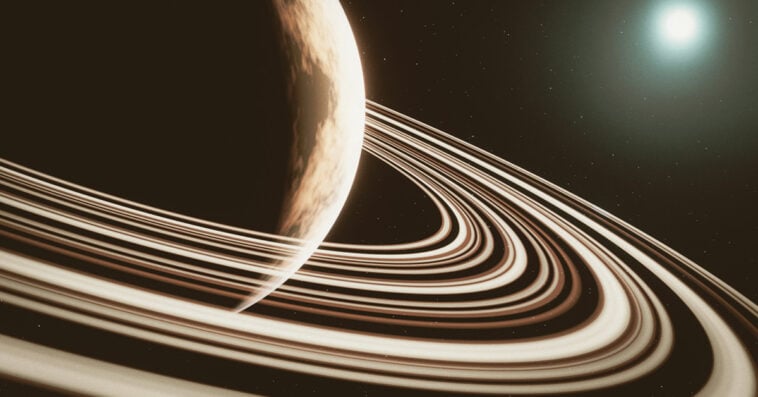
Behind the serene, glowing beauty of Saturn’s rings lies a story of cosmic chaos. Once thought to be as old as the planets themselves, these icy bands may actually be surprisingly young, and their creation was far from peaceful. According to a new study, Saturn’s largest moon, Titan, may have formed from the collision of two ancient moons — an event that could also explain the origin of the planet’s iconic rings.
How two ancient moons became one
Based on research led by SETI Institute scientist Matija Ćuk, Titan might actually be a second-generation world born from a massive prehistoric impact. By utilizing advanced computer simulations, researchers explored whether a hypothetical missing moon could have wandered close enough to Saturn to trigger the formation of its rings. Instead of a simple flyby, the data pointed toward a much more violent conclusion: a direct hit with Titan itself.
The smoking gun for this theory isn’t found on Titan’s surface, but rather in its strange relationship with its neighbor, Hyperion—a small, chaotic moon that tumbles irregularly through space.
“Hyperion, the smallest among Saturn’s major moons, provided us the most important clue about the history of the system,” said Ćuk. “In simulations where the extra moon became unstable, Hyperion was often lost and survived only in rare cases. We recognized that the Titan-Hyperion lock is relatively young, only a few hundred million years old. This dates to about the same period when the extra moon disappeared. Perhaps Hyperion did not survive this upheaval but resulted from it. If the extra moon merged with Titan, it would likely produce fragments near Titan’s orbit. That is exactly where Hyperion would have formed.”
This merger model redefines our understanding of the Saturnian system. It suggests that today’s Titan is a hybrid of two ancient ancestors: a massive Proto-Titan and a smaller Proto-Hyperion. This theory solves several astronomical puzzles at once:
- The missing craters: A massive merger would have effectively reset Titan’s surface, erasing ancient impact scars and explaining why the moon looks surprisingly smooth today.
- The atmospheric mystery: Before the crash, Proto-Titan likely looked like Jupiter’s frozen moon Callisto—heavily cratered and airless. The heat and energy of the merger may have helped facilitate the thick, nitrogen-rich atmosphere we see now.
- The Iapetus tilt: The simulations show that before Proto-Hyperion was swallowed by Titan, its gravity was strong enough to tug on the distant moon Iapetus, finally explaining that moon’s strangely tilted orbit.
- A new orbit: Titan’s slightly “off-center” or eccentric orbit appears to be a lingering side effect of this moon collision, one that is slowly stabilizing over time.
How Titan’s birth created Saturn’s rings
For over a decade, scientists have suspected that the rings are actually the “shrapnel” from a series of high-speed collisions between medium-sized moons closer to the planet. This theory gained significant ground following complex simulations by NASA Ames Research Center and the University of Edinburgh, which revealed a fascinating cycle: while most debris from such crashes eventually clumps back together to form new moons, a specific portion is pulled inward by gravity to form a flat, shimmering disk of rings.
However, the “trigger” for this destruction remained a mystery until now. While older theories blamed solar influence, the latest research led by Ćuk suggests that the Titan merger itself was the catalyst for the carnage.
As Titan settled into its new, slightly wobbly or eccentric orbit, it began to bully the smaller moons located closer to Saturn. This happened through a phenomenon called orbital resonance, a gravitational sweet spot where the orbits of two objects align in a way that amplifies their pull on each other.
As Titan’s orbit expanded, it essentially kicked these inner moons out of their stable paths, and the consequences were catastrophic. The smaller moons were forced into oval-shaped paths that crossed into their neighbors’ territory. These unstable paths led to inevitable, high-velocity mid-air collisions. While much of the wreckage reformed into the moons we see today, the remaining dust and ice were captured by Saturn to create the rings.
Because this gravitational chain reaction could only happen after Titan was formed, the timeline fits perfectly with the rings’ estimated age of just 100 million years.
Can NASA’s Dragonfly solve the mystery?
The theory that a massive moon merger created both Titan and Saturn’s rings is compelling, but how do we prove a “crime” that happened hundreds of millions of years ago? The answer may arrive in 2034 with NASA’s Dragonfly mission. This car-sized, nuclear-powered octocopter is designed to do what no previous mission could: hop across the surface of Titan to conduct a high-tech forensic investigation. Dragonfly will act as a mobile laboratory, using its advanced suite of instruments to search for geological fingerprints left behind by the presumed ancient collision.
Source: SETI Institute