
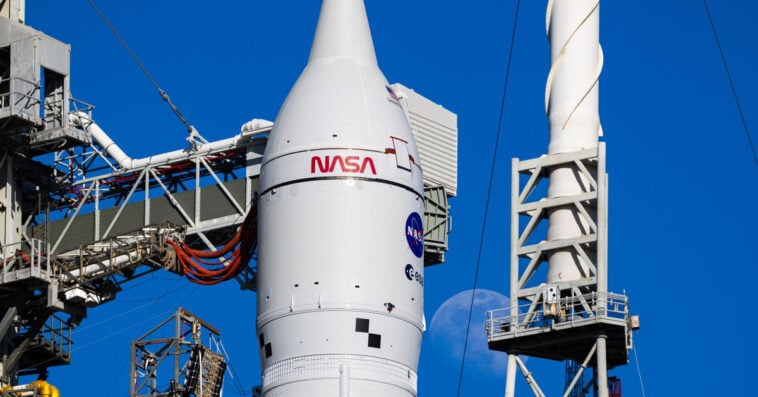
NASA’s long‑awaited return to the Moon has hit another snag, delaying the first crewed lunar flight in more than five decades since the Apollo era. The Artemis II mission, originally scheduled for early February, has been postponed to at least March after engineers uncovered technical issues during a critical pre‑launch test. Read on to find out the reasons behind the delay and how the space agency is addressing them.
NASA delays Artemis II launch after pre-flight test issues
NASA has officially shifted its sights to March 2026 for the historic Artemis II mission. Initially scheduled to launch as early as February 8, the mission’s timeline was adjusted following a grueling wet dress rehearsal that concluded early Tuesday morning.
While the test was a vital milestone for the massive Space Launch System (SLS) rocket, it wasn’t without its hurdles. The cold weather at the Kennedy Space Center caused a delayed start, and engineers eventually encountered several technical difficulties that halted progress. To ensure the safety of the four-person crew (NASA’s Reid Wiseman, Victor Glover, and Christina Koch, as well as the Canadian Space Agency’s Jeremy Hansen), NASA has opted for a thorough data review and a second practice countdown before clearing the vehicle for flight.
Addressing the setback on X, NASA Administrator Jared Isaacman emphasized that these trials are built to find failure points on the ground rather than in the air. “With more than three years between SLS launches, we fully anticipated encountering challenges,” Isaacman wrote in an X post. “That is precisely why we conduct a wet dress rehearsal. These tests are designed to surface issues before flight and set up launch day with the highest probability of success.”
What happened during the wet dress rehearsal
During the Artemis II wet dress rehearsal, NASA tested the fully integrated SLS rocket by filling it with over 700,000 gallons of super-chilled propellants and simulating a countdown to liftoff. “This was first opportunity for us to get the integrated stack for Artemis II on the launchpad with all the systems working together,” said John Honeycutt, chair of the Artemis II Mission Management Team. “To me, the big takeaway was we got a chance for the rocket to talk to us, and it did just that.”
The test ran into hydrogen leak issues just hours in, echoing similar problems from Artemis I in 2022. Honeycutt explained that the liquefied hydrogen, kept at minus 423°F, is difficult to contain due to its tiny molecular structure. “On the ground, we’re pretty limited as to how much realism we can put into the test… This one caught us off guard,” he said.
After addressing the leaks by switching to “replenish mode” — topping off the fuel as small amounts boiled off — another problem arose when the closeout crew encountered a valve that had been inadvertently vented, delaying the simulated launch. NASA ultimately stopped the countdown with about five minutes remaining due to a spike in the liquid hydrogen leak rate, ending the pretend four-hour launch window that began at 9 p.m. ET Monday.
What’s next for Artemis II?
Following the recent setbacks, NASA is recalibrating its strategy to clear the remaining hurdles for its lunar return. According to Charlie Blackwell-Thompson, NASA’s Exploration Ground Systems launch director, the upcoming wet dress rehearsal will focus specifically on “the remaining objectives that occur after the 5-minute countdown mark that were not achieved during Monday’s test.”
Additionally, NASA engineers are currently weighing whether the SLS and Orion capsule can stay on the pad or if they require a trip back to the Vehicle Assembly Building. While much of the troubleshooting can be handled on-site, a “rollback” becomes mandatory if the mission slides past March. This is due to the limited lifespan of batteries located in the rocket’s upper stage, which would need to be replaced before flight.
The delay has also temporarily changed the itinerary for the four-person crew. After entering quarantine in Houston on January 21, the astronauts have been released and will delay their arrival at the Kennedy Space Center. They are expected to re-enter isolation roughly two weeks prior to the next launch attempt.
NASA has identified several potential launch dates in early March, specifically March 6, 7, 8, 9, and 11. This mission is no small feat; once cleared, Artemis II will propel its crew on a 10-day odyssey that could set a new record for the farthest distance humans have ever traveled from Earth.
“With March as the potential launch window, teams will fully review data from the test, mitigate each issue, and return to testing ahead of setting an official target launch date,” NASA stated in a recent update.