
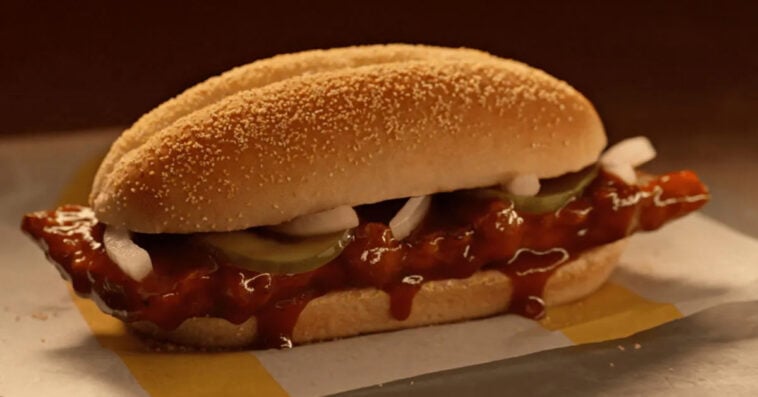
For decades, the McRib has enjoyed a cult-like following, with fans counting down the days until its “limited-time” return. But a new legal firestorm is questioning whether the sandwich is actually what it claims to be. A recently filed class-action lawsuit alleges that the iconic, bone-shaped patty is a masterclass in culinary deception, constructed not from prime rib meat, but from a processed blend of lower-grade pork cuts such as shoulder and heart. With the fast-food giant accused of tricking millions of fans, people are starting to ask: Is the McRib just a big marketing lie? Keep reading to find out what’s actually hidden under all that barbecue sauce, and see if McDonald’s will be legally required to give their famous sandwich a brand-new name.
The lawsuit challenging what’s really in McDonald’s McRib
A newly filed lawsuit is putting McDonald’s signature McRib under legal scrutiny, with four plaintiffs alleging in U.S. District Court for the Northern District of Illinois that the sandwich “does not contain any actual pork rib meat at all,” despite how it is marketed.
According to the complaint, the plaintiffs claim that “despite its name and distinctive shape, its meat patty has been deliberately crafted to resemble a rack of pork ribs,” creating the impression that it is made from rib meat. Instead, the lawsuit alleges the patty is composed of ground portions of lower-grade pork products, including, inter alia, pork shoulder, heart, tripe, and scalded stomach.
The McRib, which returned to select McDonald’s locations in November, is described by the company as “seasoned boneless pork dipped in a tangy BBQ sauce, topped with slivered onions and tangy pickles, all served on a toasted homestyle bun.” First introduced in 1981, the sandwich developed a devoted fan base before being removed from the regular menu in the early 2000s, reappearing only as a limited-time offering since then.
The plaintiffs argue that branding the sandwich as the “McRib” amounts to “a deliberate sleight of hand,” contending that such marketing leads customers to expect “pork ‘rib’ meat, which is prized by consumers for its high fat content and rich flavor.”
McDonald’s vows quality, refutes McRib lawsuit allegations
McDonald’s has pushed back strongly against the allegations, calling the claims “meritless” and arguing that the “lawsuit distorts the facts.”
While the complaint alleges that the McRib patty is made from ground portions of lower-grade pork products such as, inter alia, pork shoulder, heart, tripe, and scalded stomach, the company firmly disputes that characterization. McDonald’s says it has “always been transparent about our ingredients,” explaining that the sandwich begins with 100% seasoned boneless pork that is dipped in a tangy BBQ sauce.
Emphasizing its standards, a company spokesperson said, “Food quality and safety are at the heart of everything we do – that’s why we’re committed to using real, quality ingredients across our entire menu. Our fan-favorite McRib sandwich is made with 100% pork sourced from farmers and suppliers across the U.S. – there are no hearts, tripe, or scalded stomach used in the McRib patty as falsely alleged in this lawsuit.”
What’s next for the McRib Lawsuit?
The legal battle over McDonald’s iconic McRib is still in its early stages. Filed in late December 2025, the four plaintiffs are seeking to represent all McRib buyers over the past several years.
At this point, the court has not ruled on major procedural steps, including whether the case can proceed as a class action, and no trial date has been set. Legal experts say consumer class actions often involve months of motions, discovery, and negotiations before reaching a trial or settlement, meaning it could take a year or longer before a final decision is reached.
If the plaintiffs prevail, McDonald’s could face financial damages, such as refunds or compensation to affected customers, as well as injunctive measures requiring changes in marketing or labeling to prevent future alleged deception. Many cases, however, end in a settlement before reaching trial. On the other hand, if McDonald’s successfully defends the lawsuit, the allegations could be dismissed entirely, leaving the company’s marketing and ingredient practices intact.
Source: Fox Business