
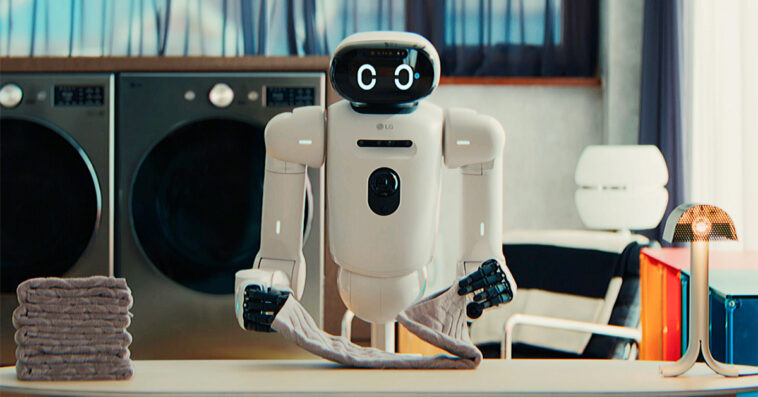
When LG Electronics takes the stage at CES 2026 to unveil its most ambitious creation yet, science fiction will suddenly feel a lot closer to everyday life. Hinting at a future that could make The Jetsons seem like yesterday’s news, the South Korean tech giant introduces LG CLOiD, a humanoid home robot built around its “Zero Labor Home” vision—one that doesn’t just vacuum your floors but actually cooks your meals, does the laundry (yes, including folding), and tackles dishes and other chores while you focus on everything else. With advanced AI, dexterous arms, and seamless smart-home integration, CLOiD promises to redefine what “help around the house” really means. Is this the moment robots finally take over our to-do lists for good?
LG brings its Zero Labor Home concept to life with CLOiD
LG CLOiD is an AI-powered home robot set to make its first public appearance at CES 2026. Created to manage and coordinate everyday household chores across smart appliances, CLOiD aims to minimize both the time and physical effort spent on routine tasks. The robot reflects LG’s ongoing push into advanced home robotics, combining its Self-Driving AI Home Hub technology with the broader LG ThinQ smart home ecosystem to bring a more intuitive, hands-free living experience closer to reality.
During CES 2026, LG will showcase CLOiD in a range of simulated home settings that highlight its real-world potential. In one demonstration, the robot prepares breakfast by retrieving milk from the refrigerator and placing a croissant into the oven. Once residents leave the house, CLOiD seamlessly shifts into chore mode — starting laundry cycles, removing clothes after drying, and neatly folding and stacking garments. These scenarios underscore the robot’s ability to recognize daily routines, interpret user needs, and precisely control connected appliances without manual input.
Attendees visiting CES 2026 from January 6 to 9 will be able to see CLOiD in action at LG’s booth (#15004) inside the Las Vegas Convention Center, where the company will bring its Zero Labor Home concept to life through immersive, everyday use cases that hint at how domestic life could soon be transformed.
A closer look at LG CLOiD’s human-like design and intelligence
LG CLOiD is designed with a human-inspired form, specifically tailored for real-world home environments. The robot features a head unit mounted on a torso with two fully articulated arms, all of which are supported by a wheeled base capable of autonomous navigation. Its adjustable torso can tilt and shift height, allowing CLOiD to comfortably reach items from knee level up to higher surfaces such as countertops and shelves, making it practical for everyday tasks throughout the home.
Each robotic arm mirrors the flexibility of a human limb, offering seven degrees of freedom across the shoulder, elbow, and wrist. This range of motion enables forward, backward, rotational, and side-to-side movement, while the hands are equipped with five independently controlled fingers for precise handling. Together, these capabilities allow CLOiD to grip, lift, and manipulate a wide variety of household items, whether it’s handling dishes in the kitchen, managing laundry, or assisting in shared living spaces.
Mobility comes from a wheeled base powered by autonomous driving technology developed through LG’s experience with robot vacuums and its Self-Driving AI Home Hub. The low-profile design keeps the center of gravity close to the ground, enhancing stability and safety while reducing the risk of tipping—an important consideration in homes with children or pets. The wheeled format also offers a cost-efficient and reliable way for the robot to move smoothly between rooms.
At the top, CLOiD’s head acts as a mobile AI command center. It houses the robot’s main processing chipset, along with a display, speaker, cameras, and an array of sensors, all supported by voice-based generative AI. These components enable natural communication through spoken responses and expressive visual cues, while also allowing the robot to observe its surroundings, learn household routines, and manage connected appliances intelligently.
The AI engine behind LG CLOiD
Powering CLOiD’s entire system is LG’s Physical AI technology, which blends advanced perception and action models. A Vision Language Model (VLM) turns visual input, such as images and video, into structured, language-based understanding, while Vision Language Action (VLA) converts visual and verbal instructions into precise physical movements. Trained on tens of thousands of hours of household task data, these models allow CLOiD to recognize appliances, interpret user intent, and carry out context-aware actions like opening doors, moving objects, or coordinating chores seamlessly across the home.
CLOiD becomes even more powerful when paired with LG’s broader smart home ecosystem, including the ThinQ AI Home Platform and the ThinQ ON hub. Through this deep integration, the robot can seamlessly communicate with and coordinate multiple connected appliances, turning individual smart devices into a unified system. The result is a more responsive home where CLOiD can manage, sequence, and optimize household tasks across LG’s product lineup, extending its role from a helpful assistant to a central conductor of the connected home.
“The LG CLOiD home robot is designed to naturally engage with and understand the humans it serves, providing an optimized level of household help,” said Steve Baek, president of the LG Home Appliance Solution Company, in a statement. “We will continue our relentless efforts to achieve our Zero Labor Home vision, making housework a thing of the past so that customers can spend more time on the things that really matter.”
Source: LG Electronics