
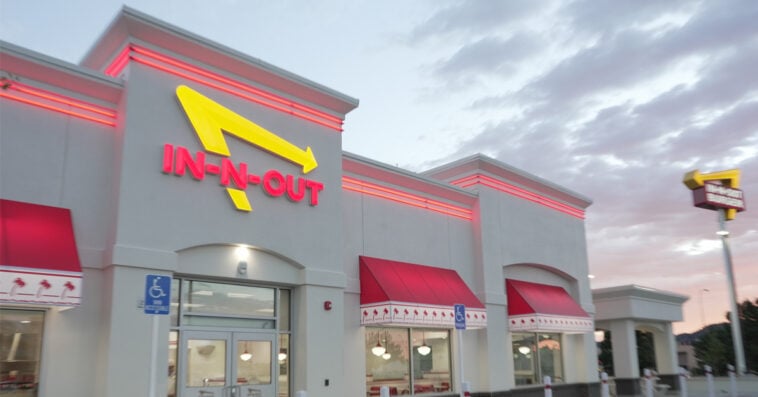
As the frenzy around the quirky “6‑7” meme swept through TikTok and school hallways, some fast-food chains like Wendy’s and Pizza Hut playfully embraced the craze with their respective “67-cent Frosty deal” and “67-cent wings.” In-N-Out, however, took the opposite route, removing the number 67 from its ticket order system entirely. So why did the beloved West Coast burger chain choose caution over clout?
Why did In-N-Out retire number ‘67’?
In-N-Out Burger has officially scrapped the number “67” from its order system, following the runaway popularity of the viral “6‑7” meme. What began as a harmless joke among teens quickly turned chaotic, with excited crowds cheering and causing disruptions whenever the number was called at the register or appeared on the counter.
An employee at a Los Angeles location confirmed to People that the change happened about a month ago and revealed that “69” has also been removed for similar reasons. Videos of the antics have spread across TikTok and other social media platforms, turning ordinary order numbers into an unexpected stage for viral mischief.
The removal first drew attention on Reddit, where a user observed that after order 66, the system jumped straight to 68. “Now I’m curious if or why they removed it,” they wrote, prompting others to explain the connection to the “6‑7” craze.
“Viral 6‑7. All the kids are yelling these days. My In-N-Out also skips this after a while; kids kept making a commotion when the number was called,” one commenter replied. Another jokingly pointed out that those unfazed by the missing number were “probably over 15.”
What does ‘6-7’ mean?
The phrase “six seven” doesn’t have a single, fixed meaning, but it has gained popularity in a few notable ways. Some associate it with the song Doot Doot (6 7) by Skrilla, which repeatedly features the lyric “6‑7,” while others link it to NBA star LaMelo Ball, whose height is 6’7″.
In October, Dictionary.com officially recognized “6‑7” as the 2025 Word of the Year, defined as “a viral, ambiguous slang term that has waffled its way through Gen Alpha social media and school hallways.”
“While the term is largely nonsensical, some argue it means ‘so-so,’ or ‘maybe this, maybe that,’ especially when paired with a hand gesture where both palms face up and move alternately up and down,” the official definition reads, adding, “Because of its murky and shifting usage, it’s an example of brainrot slang and is intended to be nonsensical and playfully absurd.”
Steve Johnson, director of lexicography for the Dictionary Media Group at IXL Learning, added of “6-7”: “It’s part inside joke, part social signal and part performance. When people say it, they’re not just repeating a meme; they’re shouting a feeling. It’s one of the first Words of the Year that works as an interjection, a burst of energy that spreads and connects people long before anyone agrees on what it actually means.”
Sources: People, Fox 5 Atlanta